
What Is S235 Steel Sheet Pile Used For?

S235 Steel Sheet Pile is widely used to create strong, continuous earth-retaining barriers. Its interlocking edges form a relatively watertight wall when driven into soil. Engineers commonly select it for excavation support, waterfront structures, flood protection, and temporary cofferdams. The steel grade typically offers a minimum yield strength near 235 MPa, but product specifications must be confirmed before design.

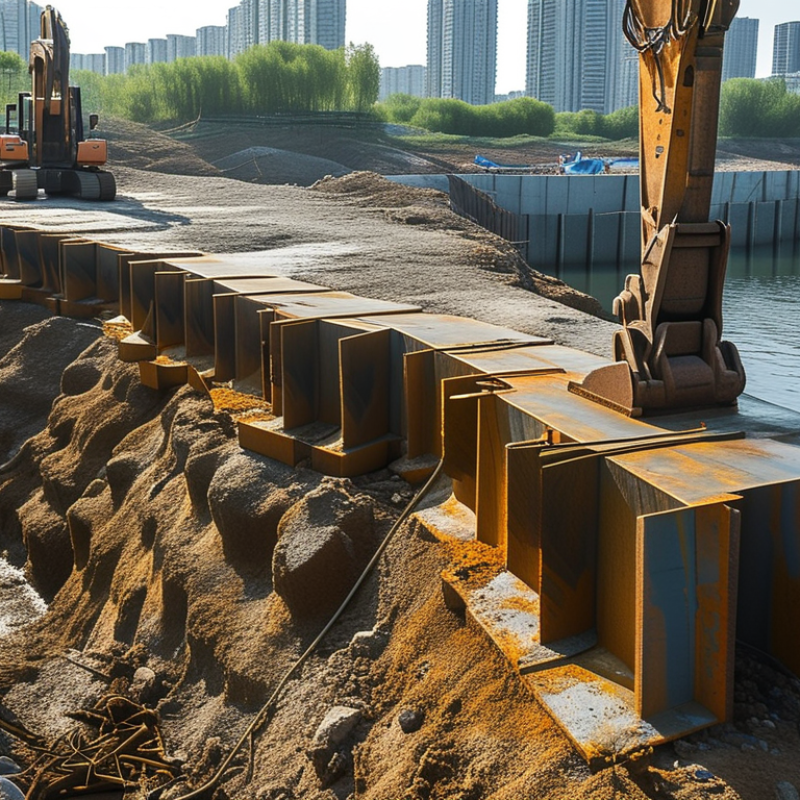
On a construction site, sheet piles may surround a deep basement excavation or protect workers beside a river. Vibratory hammers drive the sections into the ground, while walers and braces control movement. A well-planned installation limits soil loss, reduces water inflow, and protects nearby roads or buildings. S235 Steel Sheet Pile can also support quay walls, bridge foundations, drainage channels, and other civil engineering works.

The choice is not universal. Soil density, groundwater pressure, driving resistance, corrosion exposure, and wall length all affect performance. A thin section may appear economical, yet excessive deflection can create costly problems. That lesson is easy to overlook. Engineers should check section modulus, embedment depth, connection details, and temporary loading conditions. They should also inspect interlocks after driving, especially where alignment changes.

Field results depend on more than steel strength. Installation quality matters greatly. Welding, cutting, lifting, and coating work require controlled procedures and competent supervision. In marine or chemically aggressive environments, corrosion allowances or protective systems may be necessary. The final design should follow applicable standards, geotechnical data, and verified manufacturer information. This article explains where S235 Steel Sheet Pile performs well, where limitations appear, and how practical decisions influence safety, durability, and project cost.
What Is S235 Steel Sheet Pile Used For?

Material Properties and Grades of S235 Steel Sheet Piles

What Is S235 Steel Sheet Pile Used For?

Material Properties and Grades of S235 Steel Sheet Piles

S235 steel sheet piles are commonly used for temporary retaining walls, excavation support, cofferdams, and flood protection. Their interlocking edges form a continuous barrier that holds back soil and water. In site conditions, they are often selected when moderate strength, practical fabrication, and controlled project costs matter.

The S235 designation comes from the European structural steel standard EN 10025-2. It indicates a minimum yield strength of 235 MPa for thinner sections. Yield strength may reduce as material thickness increases. Typical tensile strength ranges from about 360 to 510 MPa, depending on the grade and thickness. The steel also offers useful ductility and generally good weldability.

S235JR, S235J0, and S235J2 are common grades. The suffix identifies impact toughness testing at different temperatures. S235JR is tested at +20°C, S235J0 at 0°C, and S235J2 at -20°C. Colder working environments may require greater toughness.

That detail matters.

S235 is not stainless steel. Without coatings, cathodic protection, or suitable corrosion allowance, exposed piles can lose thickness in wet or saline ground. A frequent mistake is treating every S235 pile as identical. Engineers should verify the mill certificate, thickness, impact requirement, and section properties before installation. The grade alone does not determine wall performance. Soil pressure, water level, driving method, and unsupported length still control the design.

Common Construction Applications of S235 Steel Sheet Piles

What Is S235 Steel Sheet Pile Used For?

S235 steel sheet piles are widely used for retaining soil and controlling water during construction. Under EN standards, S235 commonly indicates a minimum yield strength of about 235 MPa, depending on thickness and specification. Their interlocking edges create a continuous wall with useful resistance to earth pressure. Engineers still verify the exact grade, dimensions, and loading conditions before selection.

In deep excavations, these piles support temporary earth-retaining walls around basements, foundations, and underground utility work. They also form cofferdams, allowing crews to work in relatively dry areas near rivers, ports, and drainage channels. Bridge abutments and quay structures may use S235 piles when soil movement requires firm lateral support. On restricted sites, their narrow profile saves working space. This matters beside busy roads or existing buildings.

A common site oversight is ignoring installation conditions. Driving conditions matter. Hard gravel, buried concrete, or dense fill can damage interlocks or slow installation. S235 may suit many projects, but it is not automatically the best choice for every load or exposure level. Engineers should check bending stress, embedment depth, groundwater pressure, and corrosion allowance. In marine environments, protective measures may be necessary. Practical decisions also depend on whether the wall will be removed or remain permanently.

What Is S235 Steel Sheet Pile Used For?

Minimum yield strength of S235 steel by nominal material thickness, based on EN 10025-2 values.

S235 steel sheet piles are commonly used for temporary retaining walls, excavation support, cofferdams, riverbank protection, flood-control structures, quay walls, and other earth-retaining applications. The interlocking sheet pile sections form a continuous wall that helps retain soil and control water movement.

The chart shows the specified minimum yield strength decreasing as nominal thickness increases. Actual project suitability depends on the sheet pile profile, section modulus, corrosion allowance, soil pressure, water levels, driving conditions, and structural design requirements.

Source basis: EN 10025-2 nominal minimum yield strength values for S235 steel. Product certificates and project-specific engineering calculations should be checked before construction.

How S235 Steel Sheet Piles Support Excavations and Retaining Walls

S235 steel sheet piles are widely used to support excavations and retaining walls. EN 10025-2 specifies a minimum yield strength of 235 MPa for S235 steel, typically at thicknesses up to 16 millimetres. Their interlocking edges create a continuous barrier, limiting soil movement and water migration around a construction site. In practice, crews install the piles with vibration or pressing equipment, then connect them to walers, struts, or ground anchors.

For deep excavations, the wall transfers lateral earth pressure into the embedded section and its support system. CIRIA C760, a recognised guide for embedded retaining walls, stresses that design must consider soil stiffness, groundwater, excavation stages, and nearby structures. This matters beside roads or old masonry buildings, where even small ground movements can cause cracking. S235 is practical, but steel grade alone does not determine performance. Soil conditions can change sharply over a few metres. That assumption is easy to miss.

Tips: Check the mill certificate, pile thickness, interlock condition, and corrosion allowance before installation. Record vibration, wall movement, and groundwater levels during each excavation stage. A simple monitoring plan helps, though it cannot replace competent geotechnical design. Temporary works also deserve permanent-quality checks.

What Is S235 Steel Sheet Pile Used For? — How S235 Steel Sheet Piles Support Excavations and Retaining Walls

Data Dimension S235 Steel Sheet Pile Information How It Supports Excavations and Retaining Walls
Steel grade S235 is a non-alloy structural steel grade specified in EN 10025-2. The designation indicates a minimum yield strength of approximately 235 MPa for products up to 16 mm thick. Provides a defined strength level for designing temporary or permanent sheet-pile walls, subject to the verified product certificate and project calculations.
Yield strength by thickness Typical minimum values for S235 structural products are 235 MPa for thicknesses up to 16 mm, 225 MPa for thicknesses over 16 to 40 mm, and 215 MPa for thicknesses over 40 to 80 mm. Larger thickness ranges may have lower specified minimum values. Thickness must be considered when checking bending resistance, section capacity, and allowable construction stresses.
Tensile strength Common EN 10025-2 S235 product ranges are approximately 360–510 MPa for thicknesses up to 40 mm and approximately 350–510 MPa for greater thicknesses, depending on the product range. Helps the sheet pile resist tensile stresses caused by bending, interlock forces, handling, and temporary construction conditions.
Elastic modulus Approximately 210 GPa for structural steel. Used to estimate wall deflection and bending stiffness when analyzing excavation movements and lateral earth pressure.
Density Approximately 7,850 kg/m³. Allows engineers to estimate the weight of sheet-pile sections, lifting requirements, transportation loads, and self-weight effects.
Typical wall function Interlocking steel sheets form a continuous wall when driven or vibrated into the ground. The continuous wall retains soil, limits soil migration, and creates a stable boundary around an excavation.
Excavation support Used for construction pits, utility trenches, basement excavations, bridge approaches, and temporary work platforms. Supports lateral soil and water pressures while allowing work to proceed inside the protected excavation.
Permanent retaining walls Used for waterfront edges, quay structures, road and rail earthworks, flood protection, and grade separation. Provides long-term retention where the wall is designed for structural loading, drainage, durability, and service-life requirements.
Water cutoff capability Interlocked sheets can reduce groundwater flow, although watertightness depends on interlock condition, installation quality, soil conditions, and any approved sealant system. Helps reduce water inflow into excavations and can separate retained soil from adjacent water-bearing ground. It is not automatically a fully watertight barrier.
Load resistance Resistance is governed by the section modulus, moment of inertia, sheet thickness, embedment, steel grade, support conditions, and connection details. Proper embedment and bracing allow the wall to resist bending from active or at-rest earth pressure, surcharge loads, hydrostatic pressure, and construction loads.
Installation methods Common methods include vibratory driving, impact driving, and pressing, selected according to ground conditions, access, noise limits, and vibration sensitivity. Appropriate installation reduces damage to interlocks and helps achieve the embedment needed for wall stability and deformation control.
Temporary bracing Walls may be supported by walers, struts, rakers, or ground anchors when the excavation depth or loading requires additional restraint. Bracing reduces bending moments and horizontal deflection, particularly in deep or congested excavations.
Durability considerations Unprotected carbon steel can lose thickness through corrosion. The corrosion rate depends on soil chemistry, groundwater, oxygen availability, marine exposure, and service conditions. Designers may specify a corrosion allowance, coating, cathodic protection, concrete encasement, or another durability measure based on the required service life.
Connection and interlock checks Sheet-pile interlocks must be checked for engagement, damage, alignment, and resistance to separation or leakage. Reliable interlocks maintain wall continuity and help transfer forces between adjacent sheets during driving and service.
Design verification Design should assess earth pressure, groundwater, surcharge, global stability, basal heave, piping, bending, shear, deflection, embedment, and construction stages. Confirms that the S235 sheet-pile wall is suitable for the actual soil profile, excavation geometry, water conditions, and project duration.
Main advantage Steel sheet piles provide high strength with relatively small wall thickness and can often be installed and removed quickly. They are effective where construction space is limited, rapid installation is important, or reusable temporary support is required.

Note: The values shown are general engineering reference data. Final sheet-pile selection must use the manufacturer’s certified section properties, the applicable edition of EN 10025-2, and a project-specific geotechnical and structural design.

Installation Methods and Equipment for S235 Steel Sheet Piles

S235 steel sheet piles are commonly used for retaining walls, cofferdams, excavation support, and temporary ground barriers. Their interlocking edges form a continuous wall that limits soil movement and reduces water migration. S235 steel offers a practical balance between strength, weldability, and cost for many civil engineering projects. Thickness, pile length, soil pressure, and corrosion exposure must be checked by a qualified engineer.

Installation usually begins with a crane, lifting clamps, and a temporary guide frame. The guide keeps each pile aligned before driving starts. A vibratory hammer is suitable for many sands, gravels, and soft soils because it installs piles quickly with lower noise than impact driving. An impact hammer may be needed when dense layers resist penetration. Hydraulic press-in equipment can reduce vibration near fragile buildings, buried utilities, or occupied sites. Predrilling may help in very hard ground, but it can reduce wall stability if poorly controlled.

Small details matter. Crews should inspect interlocks, check pile straightness, and monitor vibration during installation. Survey equipment confirms position and verticality after each panel. Experienced teams also watch for refusal, damaged locks, and unexpected groundwater. Yet the method is not foolproof. A design may look efficient on paper, while actual ground conditions demand slower driving or a different sequence. Careful records of driving resistance and alignment support safer decisions during the work.

Benefits, Limitations, and Selection Considerations

What Is S235 Steel Sheet Pile Used For?

Benefits, Limitations, and Selection Considerations

S235 steel sheet pile is commonly used for retaining walls, temporary excavations, cofferdams, and riverbank protection. Its nominal yield strength is about 235 MPa, depending on product thickness and applicable standards. Contractors value its practical balance of strength, weldability, and cost. It can be driven into soil, removed, and reused when the interlocks remain undamaged. On a busy site, this saves storage space and reduces material waste.

The limitations deserve equal attention. S235 may need thicker sections than higher-strength steel for the same bending demand. Corrosion can reduce wall thickness, especially near fluctuating water levels. Driving through gravel or old concrete may dent the pile and weaken its interlock. Noise and vibration can also disturb nearby buildings. Small issues become expensive quickly.

Selection should begin with soil data, groundwater levels, excavation depth, and design loads. Engineers then check bending moment, deflection, section modulus, interlock strength, and driving resistance. A corrosion allowance may be necessary for permanent structures. Installation equipment matters too; a pile suitable on paper may fail during driving. I have seen low-cost choices create delays when the soil was harder than expected. That assumption needs challenging. Review the design against local standards, inspection records, and actual site conditions before ordering.